BTdiagAI: A Web‑Deployed Hybrid Framework for Brain Tumor Classification Using Optimized MRI Preprocessing and Deep Learning Fusion
Public Website Demo
Journal / Venue
Healthcare Technology Letters
Paper Link
View PaperJournal Metrics
Metrics Updated: April 2026Cite Score
5.8
Impact Factor
3.3
Quartile
Q2
Keywords
Authors
Faysal Ahmmed
faysalahmmed4200@gmail.comAsef Rahman Antik
asefrahman2001@gmail.comAjmy Alaly
alalyajmy@gmail.comSamanta Mehnaj
samantamehnaj2001@gmail.comMd Sadi Al Huda
Md Asraf Ali
Overview
A comprehensive framework for classification using optimized MRI and fusion.
Abstract
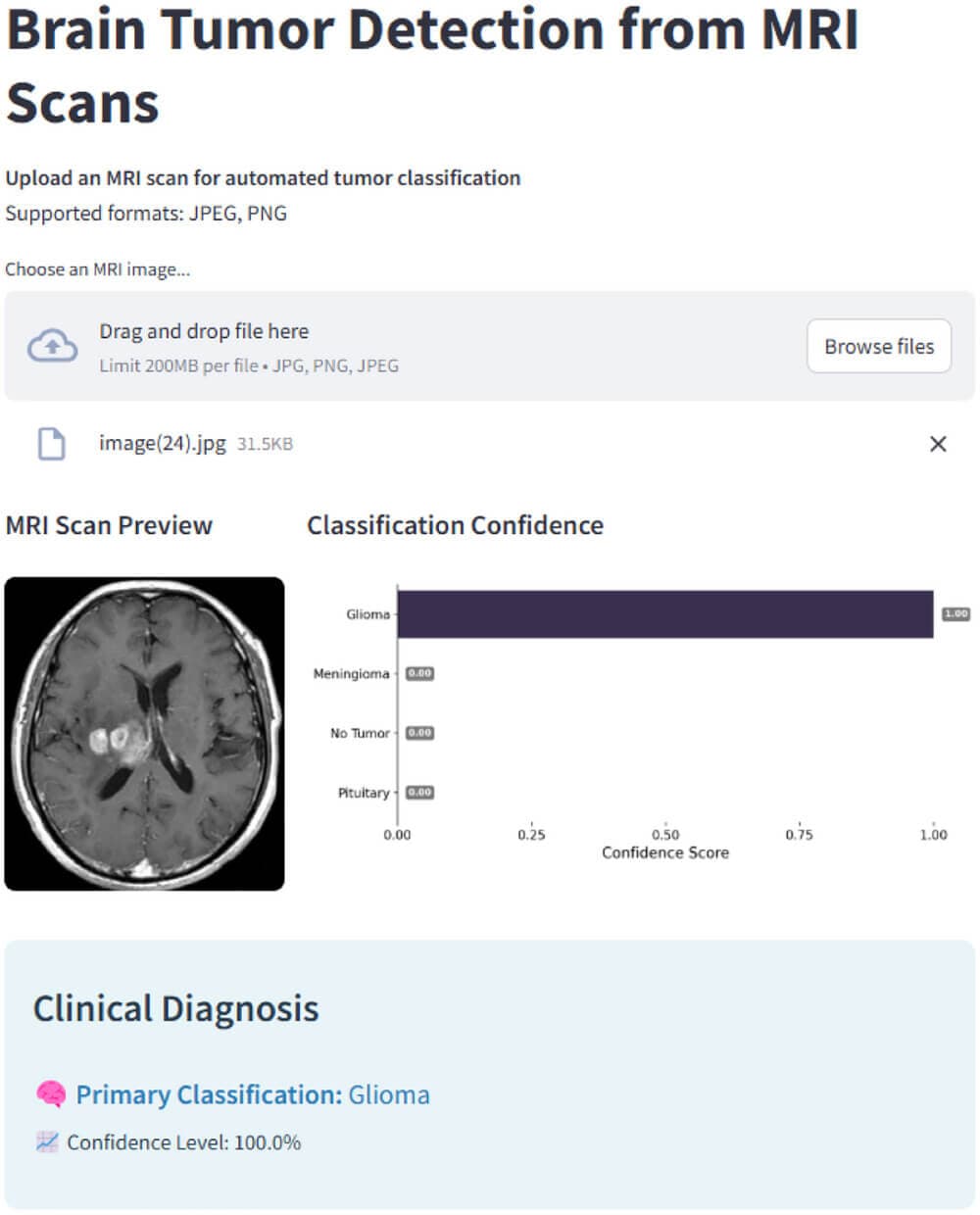
Brain tumor diagnosis via MRI remains challenging due to imaging artifacts, tumor heterogeneity, and time-intensive manual evaluations that introduce variability. While preprocessing is critical for accuracy, comparative analyses of techniques are limited, as research often prioritizes algorithmic advancements. This study systematically evaluates five MRI preprocessing methods (CLAHE, Nyul normalization, N4 bias correction, template registration, White Stripe normalization) and proposes a deep learning framework integrating fine-tuned InceptionV3, DenseNet121, and Xception networks. Features from these models were concatenated, refined via ANOVA and L1max selection, and classified using machine learning. To address class imbalance, data augmentation techniques were employed, ensuring a well-distributed dataset for robust model training. All preprocessing methods achieved greater than 98% accuracy, with CLAHE outperforming others (99.8% on Dataset 1; 99.61% on Dataset 2) while requiring minimal computational resources. The framework's efficacy is demonstrated through a publicly accessible web platform BTdiagAI, that enables users to upload brain MRI scans for automated classification into four tumor categories: benign, pituitary, glioma, and meningioma. This deployment underscores the clinical applicability of the solution, offering rapid, scalable diagnosis with state-of-the-art accuracy. The study highlights preprocessing as pivotal for MRI-based tumor diagnosis, advocating CLAHE for its balance of efficiency and performance.